Absolute Steel structures are designed to be anchored to a concrete footing or slab, or directly to the earth.
SPECIAL NOTE FOR COLD WEATHER AREAS: The concrete applications described below do not account for frost line requirements. If you live in an area that has very cold winters and a frost line, your concrete footings will need to be deeper than what is illustrated here. Your local building authorities can provide information on frost line requirements in your area.
Site Preparation
Preparing an area of ground for a building is fairly simple – all you’re trying to do is create a smooth, level, firm surface.
First, you’ll need to remove any vegetation, rocks and debris.
Next, make sure the ground is level. For this you can use anything from a long 2×4 and your eye or you can use a laser level and “shoot” it in. Note: Never be this casual with your forms—those are to be level and plumb.
Once you have the ground reasonably level, it may need to be compacted to create a firm surface. In some cases natural compaction will suffice.
Concrete Slab Mounting
Slab Sizing
Your slab is to be the same width as your building, and 2″ longer. For example, if you have purchased a 20′ wide by 40′ long building, your slab should be 20′ wide by 40′ 2″ long.
Slab Thickness
Your floor should be a minimum of 4” thick. The concrete’s strength should be a minimum of 2500 psi, with fiber mesh reinforcement added at the batch plant OR #3 rebar on 24” centers.
If you are planning to park large, heavy vehicles inside (such as trucks or larger RVs), you should consider making the slab 6” thick, and using 4000-psi concrete.
Be sure to saw-cut expansion joints in the slab, within an appropriate time after the pour, or troweled-in expansion joints done during the concrete finishing steps.
For the sake of estimation, we can tell you that in our local area (Phoenix, AZ), the cost for a 4″ slab runs about $4.50 per square foot. Prices in your area may be different.
Footing Requirements
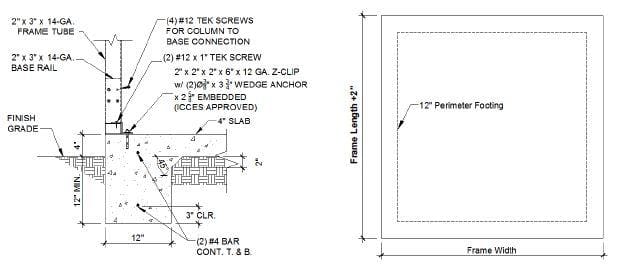
At the same time as your slab is poured, you will also need to pour perimeter footings, as illustrated below. This is called a monolithic pour or monolithic slab.
Perimeter footings should be 12″ wide, and 12” deep. (Deeper in the event you are contending with a frost line) You can include the 4” slab thickness in the 12″ total depth; in other words, the footing would extend 8″ below the slab. As shown in the detail drawings, your footings will also need continuous runs of #4 rebar along the top and bottom.
In our local area, footings of this type would cost approximately $16.50 per lineal (running) foot.
Ground Mounting with Concrete Caissons
If you choose to build your structure on cleared and leveled ground instead of on a concrete foundation, you will still need to provide concrete anchoring, in the form of caissons. In other words, you will need to dig post holes approximately 10” in diameter and 30” deep, every five feet along the length of the building. (If you have purchased a 4′-on-center frame building, the holes should be placed four feet apart.) Each hole will be filled with concrete, to form a caisson.
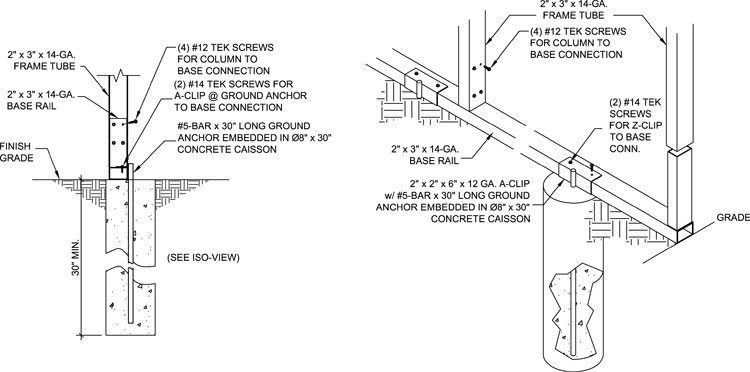
The digging of the post holes is best done with a power auger or post-hole digger, normally available from tool or equipment rental companies. Once your caisson holes are dug and the structure’s base rails are laid out, place an anchor rod in each hole (attached to the base rail as described in your instruction booklet) and fill the hole with concrete.
REMINDER: There may be additional frost line requirements in your area, which would make it necessary to make your footings or caissons deeper than indicated here. Your local building authority can provide you with information on this point.
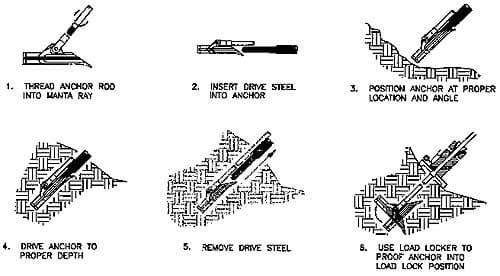
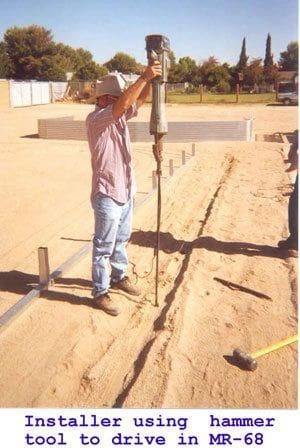
Ground Mounting with MR 68 Ground Clamps
Click here to get Instant Pricing NOW!
Let’s Start the Conversation
Please call us toll-free at 1-877-833-3237 with any questions or quote needs. We are here to help. Customer service and pricing available from 8:00 am to 5:00 pm Arizona time Monday – Friday.